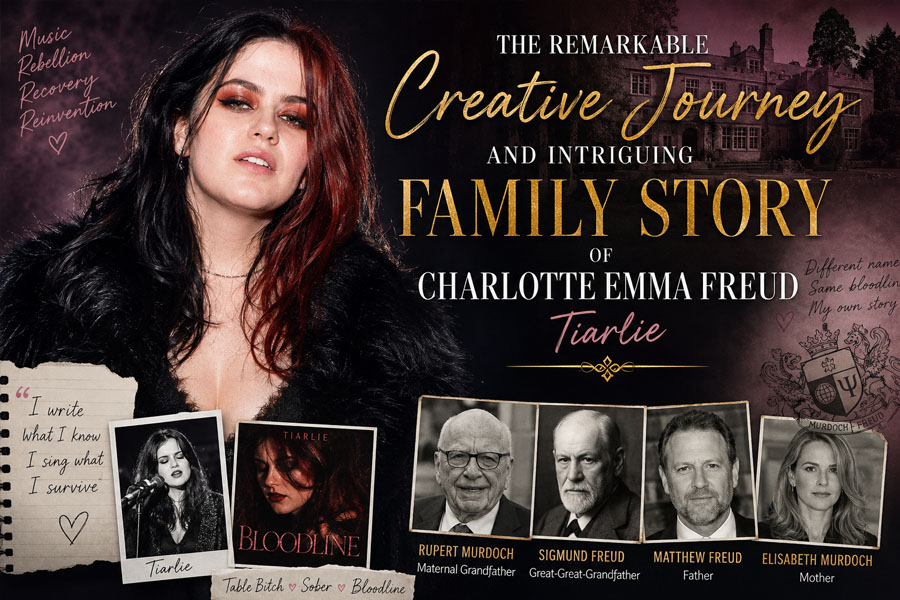
Charlotte Emma Freud, born on 17 November 2000, grew up at the intersection of two names that seem almost too famous to fit on the same family tree. On her mother’s side stands the Murdoch dynasty, associated with newspapers, television, and one of the most powerful media empires of the modern era. On her father’s side comes the Freud family, a lineage of psychoanalysis, literature, art, broadcasting, and theatre.
Yet Charlotte has spent much of her life trying to make the story about something else: music, theatre, recovery, and the difficult business of becoming her own person.
For her creative work, she has embraced the name Tiarlie, a stage identity inspired by a family cat. I find that detail particularly revealing. When your birth name carries the weight of two international dynasties, choosing a name connected to something intimate and ordinary can feel like opening a small window in a very large house.
Basic Information
| Detail | Information |
|---|---|
| Full name | Charlotte Emma Freud |
| Creative name | Tiarlie |
| Also known as | Charlotte Murdoch Freud |
| Date of birth | 17 November 2000 |
| Nationality | British |
| Parents | Elisabeth Murdoch and Matthew Freud |
| Maternal grandfather | Rupert Murdoch |
| Paternal grandfather | Sir Clement Freud |
| Famous ancestor | Sigmund Freud |
| Profession | Singer songwriter and musical theatre writer |
| Musical interests | Pop, alternative music, musical theatre and show tunes |
| Notable songs | “Table Bitch”, “Sober”, “Bloodline” |
| Former husband | Luke Storey |
| Former relationship | Isaak Presley |
| Base of creative work | London and Los Angeles |
Growing Up Inside Two Famous Dynasties
Charlotte’s family history reads almost like a screenplay.
Her mother, Elisabeth Murdoch, was born on 22 August 1968 and became a major media executive in her own right. She is the daughter of Rupert Murdoch and Anna Torv, later known as Anna Murdoch Mann. Elisabeth has built a substantial professional career beyond simply being Rupert Murdoch’s daughter, including her work with Shine and other media ventures.
Her father, Matthew Freud, born on 2 November 1963, is a prominent British public relations executive and the founder of Freud Communications. He is the son of broadcaster, writer, politician, and chef Sir Clement Freud and actress and theatre producer Jill Freud.
That combination gave Charlotte an unusual childhood. At family gatherings, conversations could involve newspapers, television, theatre, politics, literature, celebrity, business, or the psychology of the human mind. Her family tree contains enough famous names to fill several generations of cultural history.
Her maternal grandfather is Rupert Murdoch, born in 1931, the Australian-American media magnate whose career transformed newspapers and broadcasting across several continents. Her paternal great-great-grandfather is Sigmund Freud, the Austrian neurologist and founder of psychoanalysis.
It is difficult to imagine a more complicated inheritance of expectations.
Elisabeth Murdoch and Matthew Freud
Elisabeth and Matthew married in 2001 at Blenheim Palace, shortly after Charlotte’s birth. Their marriage became associated with the socially prominent group sometimes described as the “Chipping Norton set,” a circle that attracted considerable public attention because of the influence and wealth of its members.
The couple later divorced in 2014.
Charlotte has spoken about the complicated emotional terrain of growing up within such a prominent family. Rather than presenting herself as someone who effortlessly benefited from celebrity, she has described periods when she felt overlooked and sought attention in increasingly difficult ways.
She has also spoken about maintaining relationships with both parents after their separation. For a young person growing up beneath a family spotlight, divorce was not simply a private family event. It became another chapter in an already unusually visible life.
Charlotte’s Siblings and Half Siblings
Charlotte has a younger full brother, Samson Murdoch Freud, born on 13 January 2007. Public information about Samson is relatively limited, reflecting a much quieter public profile.
Her family also includes half siblings on both sides.
Through her father Matthew Freud’s earlier marriage to Caroline Hutton, Charlotte has half brothers George Rupert Freud and Jonah Henry Freud.
Through her mother Elisabeth Murdoch’s earlier marriage to Elkin Kwesi Pianim, she has half sisters Cornelia Pianim, born in 1994, and Anna Pianim, born in 1997.
The result is a large blended family connecting several branches of the Murdoch, Freud, and Pianim families.
The Murdoch Side of the Family
Charlotte’s maternal family includes some of the most recognizable figures in modern media.
Rupert Murdoch is perhaps the most famous name in the family. His influence extends across newspapers, television, publishing, and political media, while his family relationships have also attracted public fascination.
Charlotte has acknowledged the strange experience of living with that legacy. The Murdoch family has often been compared with the fictional Roy family from the television drama Succession, and Charlotte herself has discussed similarities between her family circumstances and the show’s fictional world.
The resemblance is less about individual personalities than about atmosphere: enormous wealth, complicated inheritance, powerful parents, adult children trying to establish themselves, and a family name that can become both a passport and a burden.
Charlotte has inherited that name, but she has also spent considerable energy trying to step outside it.
The Freud Family Legacy
The Freudian side is as remarkable, albeit from a different cultural perspective.
Sigmund Freud, born in 1856 and died in 1939, was one of the most significant theorists in the study of the human mind. Charlotte descended from him via his son Ernst L. Freud, then Sir Clement Freud, and finally Matthew Freud.
Sir Clement Freud, her paternal grandfather, had an incredibly diverse career. He was a broadcaster, writer, chef, and Liberal politician who served as a Member of Parliament.
Charlotte’s grandmother, Jill Freud, born June Flewett in 1927, was an actress and theatre producer who stayed involved in the performing arts.
The familial tree extends into art and literature. Charlotte’s extended family members include painter Lucian Freud, broadcaster Emma Freud, novelist Esther Freud, and fashion designer Bella Freud.
That makes Charlotte’s bequest both extraordinarily artistic and affluent. The family name is associated with both psychiatric history and a lengthy legacy of artistic endeavour.
Becoming Tiarlie
Charlotte’s decision to perform as Tiarlie represents one of the clearest attempts to create a separate artistic identity.
She has spoken about the burden attached to her surnames and about wanting her music to be judged on its own terms. The stage name gives her a little distance from the Murdoch and Freud mythology surrounding her birth name.
Music became a refuge during difficult periods of her adolescence. She trained vocally with David Grant, known for his work in British music and television, and developed a fascination with musical theatre alongside contemporary pop.
Her creative influences are eclectic. She has admired Lana Del Rey’s cinematic atmosphere and has expressed a desire to tour with her. She has also cited Olivia Rodrigo, while musical comedians such as Bo Burnham and Tim Minchin appeal to her because of their storytelling, wit, and darker humor.
That combination helps explain Tiarlie’s musical personality. Her songs can feel less like conventional pop singles and more like miniature confessionals.
Songs About Power, Addiction and Bloodlines
One of Tiarlie’s early songs, “Table Bitch,” was written when she was around 15. The track reflects her interest in characters, relationships, power, and uncomfortable human behavior.
Later came “Sober,” a much more direct examination of addiction and recovery.
Then there is “Bloodline,” a title that almost seems inevitable given Charlotte’s family history. Rather than simply celebrating inherited privilege, the song explores the darker idea of what families can pass down emotionally: pain, neurosis, expectations, and patterns of behavior.
This is where her music becomes especially personal. She has an extraordinary bloodline, but her creative work repeatedly asks what happens when inheritance is not just money or a surname, but psychology.
Adolescence and the Road to Recovery
Charlotte has been unusually candid about her teenage years.
She has described herself as a “trouble child” and has spoken about bullying connected to her family name, difficulties at elite schools, partying, addiction, eating disorders, self-harm, and serious medical episodes.
Ketamine addiction became one of the darkest chapters of her adolescence. She has discussed the nickname “K-Angel” and the chaotic lifestyle surrounding her teenage years.
By the early 2020s, however, recovery had become a central part of her story.
She began building sobriety, attending Alcoholics Anonymous meetings, and developing a different relationship with herself. Music became part of that process. Instead of being merely another form of entertainment, songwriting offered a place to turn painful experiences into something structured and creative.
That transformation is reflected directly in her work. “Sober” is not simply a title. It represents a major dividing line in her personal story.
Marriage to Luke Storey
Charlotte married musician and rapper Luke Storey, also known as Lukey Storey, in July 2022.
The ceremony took place at St Mary’s Church in Westwell, Oxfordshire, in the Cotswolds. Family members, including Rupert Murdoch, were present, and the wedding attracted attention for its distinctive visual style.
Charlotte and Luke had originally met at Laylow, the London members’ club where Luke was DJing and Charlotte was working.
The marriage lasted roughly fourteen months. Their divorce was finalized in 2023.
For Charlotte, the period around the marriage and subsequent divorce became another chapter in a broader process of reinvention. Her style changed, her music evolved, and her ambitions increasingly moved toward theatre.
Los Angeles, Isaak Presley and a New Chapter
Charlotte later spent substantial time in Los Angeles, drawn partly to the sunshine and partly to the creative opportunities available there.
In 2025, she was publicly linked to actor Isaak Presley, known for Fuller House and other screen work. The relationship was introduced publicly with a western and gothic cowboy-inspired aesthetic, fitting Charlotte’s taste for dramatic visual storytelling.
The pair lived together in Los Angeles and traveled extensively before the relationship ended later in 2025.
Her Los Angeles period also coincided with increasing attention to her personal transformation, appearance, sobriety, and creative work.
Body Image and Personal Reinvention
Charlotte has spoken openly about body image and cosmetic procedures, including a breast reduction at 21, lip filler, a single use of nose filler, and a brief trial of Ozempic that she said she stopped after experiencing depression.
She has also discussed the influence of social media filters and the pressure to look a certain way online.
These conversations fit into a larger pattern in her story. Charlotte’s public image has changed repeatedly, moving from heavily gothic and punk-inspired styling toward more polished and varied aesthetics.
I see that evolution as part of the same search for identity that led her from “Charlotte Freud” toward Tiarlie. The clothes, music, relationships, and location all change, but the central question remains the same: who is she when the famous family name is taken out of the room?
From Singer to Musical Theatre Writer
Music remains central to Charlotte’s creative life, but her ambitions have expanded.
She has increasingly focused on musical theatre writing and has worked on theatrical projects, including involvement associated with The Greatest Showman Circus Spectacular.
That direction makes sense given her lifelong fascination with show tunes and storytelling. Her musical influences are not confined to singers. She is attracted to characters, dramatic arcs, humor, theatrical spectacle, and songs that reveal something about the person singing them.
In that sense, Tiarlie’s development feels less like a shift away from music and more like music getting a bigger stage.
Charlotte Emma Freud’s Financial Background
Charlotte was born into considerable fortune, and the extent of her family’s resources is well known.
The Murdoch family has long held assets linked with a global media empire, whereas Matthew Freud established a highly successful public relations firm. Charlotte acknowledged having a financial safety net.
Nonetheless, her personal net worth has not been officially disclosed with the precision that some online celebrity profiles claim. Her access to family wealth should not be mistaken for a verifiable personal fortune.
Her more fascinating financial tale is perhaps the conflict between privilege and independence. She has never had to pretend she grew up without advantages, but she has constantly voiced a desire to create something unique to her.
A Family Story Written Across Generations
Charlotte’s family contains an unusual mixture of media power, psychoanalysis, theatre, literature, fashion, politics, and art.
| Family member | Relationship to Charlotte | Known for |
|---|---|---|
| Elisabeth Murdoch | Mother | Media executive |
| Matthew Freud | Father | Public relations executive |
| Rupert Murdoch | Maternal grandfather | Media mogul |
| Anna Murdoch Mann | Maternal grandmother | Former wife of Rupert Murdoch |
| Sir Clement Freud | Paternal grandfather | Broadcaster, writer and politician |
| Jill Freud | Paternal grandmother | Actress and theatre producer |
| Sigmund Freud | Great-great-grandfather | Founder of psychoanalysis |
| Ernst L. Freud | Great-grandfather | Architect |
| Lucian Freud | Extended paternal relative | Painter |
| Emma Freud | Paternal aunt | Broadcaster and writer |
| Esther Freud | Extended paternal relative | Novelist |
| Bella Freud | Extended paternal relative | Fashion designer |
| Samson Murdoch Freud | Younger brother | Private family member |
Charlotte stands somewhere in the middle of this enormous cultural web, but her work suggests that she does not want merely to inherit the story.
She wants to write another chapter.
FAQ
Who is Charlotte Emma Freud?
Charlotte Emma Freud is a British singer-songwriter and aspiring musical theatre writer who performs creatively under the name Tiarlie. She is the daughter of Elisabeth Murdoch and Matthew Freud.
When was Charlotte Emma Freud born?
Charlotte Emma Freud was born on 17 November 2000 in the United Kingdom.
Who are Charlotte Emma Freud’s parents?
Her parents are media executive Elisabeth Murdoch and public relations executive Matthew Freud.
Is Charlotte Emma Freud related to Rupert Murdoch?
Yes. Rupert Murdoch is Charlotte’s maternal grandfather through his daughter Elisabeth Murdoch.
Is Charlotte Emma Freud related to Sigmund Freud?
Yes. Sigmund Freud is her great-great-grandfather through her father’s family line.
What is Charlotte Emma Freud’s stage name?
Charlotte performs under the stage name Tiarlie, a name inspired by a family cat.
What songs has Tiarlie released?
Her known songs include “Table Bitch,” “Sober,” and “Bloodline,” which explore relationships, addiction, recovery, family history, and emotional inheritance.
Who did Charlotte Emma Freud marry?
She married musician and rapper Luke Storey in July 2022 in Oxfordshire. They divorced in 2023.
Who did Charlotte Emma Freud date in 2025?
Charlotte was publicly linked to actor Isaak Presley during 2025. Their relationship later ended that year.
What is Charlotte Emma Freud doing professionally?
She continues to develop her music career while increasingly concentrating on musical theatre writing and theatrical creative projects.
What are Tiarlie’s musical influences?
Tiarlie has expressed admiration for Lana Del Rey and Olivia Rodrigo while also drawing inspiration from musical theatre, show tunes, Bo Burnham, and Tim Minchin. Her work combines personal storytelling with darker, theatrical moods.
Has Charlotte Emma Freud spoken about addiction?
Yes. She has publicly discussed her teenage struggles with addiction and her subsequent recovery and sobriety, making those experiences part of her personal and artistic story.